Heat Rash vs Viral Rash in Babies and Toddlers: A Singapore Parent's Guide to Telling Them Apart

You undress your baby after a long afternoon at the playground and notice it: a scatter of tiny red bumps across the back of the neck, in the elbow creases, or down the chest. Is it heat rash from Singapore's relentless humidity, or is it a viral rash that needs a doctor's eye?
You are not alone in asking. According to the Meteorological Service Singapore's 2025 climate report, 2025 was Singapore's eighth-hottest year on record — with the hottest June ever measured and 29 days of high heat stress (up from 21 in 2024). That climate, combined with how easily babies overheat, means heat rash is genuinely one of the most common rashes Singapore parents see. But viral rashes are common too — and they can look surprisingly similar at first glance.
At Oaklife Family Clinic in Balestier, this is one of the most common questions parents bring to us. So here is the simple version: how to tell heat rash from a viral rash, what to do at home, and when to come in.

Why Rashes Are So Common in Singapore Babies
Two things make Singapore particularly tough on baby skin. First, the climate. Daytime temperatures sit between 31°C and 33°C year-round, with humidity typically above 80%. Second, baby skin is simply not built for it yet — sweat ducts in newborns are still developing and easily blocked, which is the underlying cause of heat rash.
A Medscape clinical reference on miliaria notes that miliaria rubra — the most common form of heat rash — affects up to 30% of people newly exposed to a tropical environment. For Singapore-born babies, that exposure is constant. Add a viral illness on top (which most under-twos catch several times a year), and you can see why rashes are a near-monthly question for many parents.
The good news: most rashes — heat rash and the common viral ones — are self-limiting and not dangerous. The job is just telling them apart and knowing when something else is going on. For more on rashes generally, read our broader guide on when to worry about a rash on your child.
What Heat Rash (Miliaria) Looks Like
Heat rash, also called prickly heat or miliaria, happens when sweat gets trapped under the skin because the sweat ducts are blocked. There are three forms, but the two you will actually see in your baby are:
Miliaria crystallina — the clear bumps
Tiny clear, dewdrop-like blisters that look like beads of sweat trapped on the skin. They do not itch and do not have redness around them. Most common in newborns in the first weeks of life, especially during a feverish illness. Pops easily, then resolves quickly without treatment.
Miliaria rubra — the classic prickly heat
This is the one most parents recognise. Small red bumps that may itch or feel prickly, usually clustered in areas that sweat or rub: the neck, upper chest, back, in skin folds (groin, armpits, behind the knees), and around the diaper line. Babies often look fussy or irritable in the heat but are otherwise well — eating, drinking, and acting normally.
"The single most useful question I ask parents is: how is your baby otherwise? A baby with heat rash usually looks completely well aside from the rash itself. A baby with a viral rash often has fever, a runny nose, low energy, or a poor appetite for a day or two before or during the rash." — Dr Lim Chong Soon Daniel, Senior Family Physician, Oaklife Family Clinic.
What a Viral Rash Looks Like
Viral rashes are part of how the body responds to common childhood infections. Most are not dangerous, but they look different from heat rash in several practical ways.
Common viral rashes in Singapore children:
Roseola infantum — high fever for 3 to 5 days, then a flat pink rash appears on the trunk just as the fever breaks. Most common in babies 6 months to 2 years old.
Hand, foot and mouth disease (HFMD) — small red spots and blisters specifically on the palms, soles, and inside the mouth. See our full guide to HFMD for what to do.
Chickenpox — itchy crops of red spots that turn into fluid-filled blisters, then crust over. Spreads from trunk outwards. More on this in our chickenpox guide.
Non-specific viral exanthem — a vague flat or slightly bumpy rash that comes with mild fever, runny nose, and often appears as the child is recovering from a cold-like illness.
Slapped cheek (parvovirus) — bright red flushing on both cheeks, sometimes followed by a lacy rash on the body.

How to Tell Heat Rash and Viral Rash Apart
Here is the practical comparison most parents find useful between heat rash vs viral rash:
Where it appears
Heat rash: clusters in areas that sweat or rub — neck, chest, back, skin folds, around the diaper.
Viral rash: more widespread — often on the trunk, limbs, and sometimes the face. May follow specific patterns (like cheeks for slapped cheek, or palms and soles for HFMD).
What it looks like
Heat rash: uniform tiny red or clear bumps. May feel prickly or itchy.
Viral rash: flat pink patches, raised red spots, or blisters depending on the virus. Often less uniform.
Other symptoms
Heat rash: the baby is otherwise well. Maybe fussy in the heat, but eating and drinking normally.
Viral rash: usually accompanied by fever, runny nose, sore throat, reduced appetite, or low energy — either before, during, or as the rash appears.
How fast it changes
Heat rash: improves within a few hours of cooling down. Often gone the next morning if you change the environment.
Viral rash: usually lasts 3 to 7 days regardless of cooling, and follows the course of the underlying illness.
What triggers it
Heat rash: hot day, overdressing, prolonged time in a humid environment, fever from any cause.
Viral rash: comes with or just after a cold, flu, or another viral illness — often a sibling at home or at childcare has been unwell.
When You Are Still Not Sure: A Simple Test
Cool your baby down — strip them to a vest and diaper, move them to an air-conditioned room, and wait two to three hours. If the rash improves significantly in that time, it is almost certainly heat rash. If it does not change at all, or if it is spreading or your child has a fever, treat it as a viral rash and consider a doctor visit.
"A father once brought his 9-month-old in convinced she had measles. The rash was on her neck and back, intensely red, and had appeared overnight. We popped her into the cooler consult room while he filled in the forms — by the time we examined her 20 minutes later, the rash had already faded by half. Classic heat rash. We sent them home with reassurance and air-con tips, no medicine needed." — Dr Jacquelyn Melody, Family Physician, Oaklife Family Clinic
Not sure if it's a rash or something more serious? See our guide on when to worry about your child's rash.
Home Care for Heat Rash
Heat rash almost always settles on its own once the skin can cool down. Treatment is about removing what caused it, not about creams. The KK Women's and Children's Hospital paediatric dermatology team (via HealthXchange) has clear guidance for managing baby skin conditions in Singapore's climate. The basics:
Move your baby to a cooler space — air-con or a fan helps a lot
Strip off extra layers — Singapore babies generally need fewer layers than parents instinctively put on
A lukewarm (not cold) bath, then pat dry — do not rub
Let the skin air-dry for a few minutes before redressing
Switch to loose, breathable cotton clothing
Skip thick lotions, oils, and ointments — they trap heat and can make the rash worse
If the bumps are intensely itchy, your doctor may suggest a mild over-the-counter antihistamine for older babies, or a brief course of a low-strength topical cream
What not to do
Do not apply talcum powder to the rash — it can clump in folds and worsen the blockage
Do not use heavy moisturisers like petroleum jelly during a flare
Do not bundle up your baby because they are crying — heat rash often makes babies fussy, but more clothing is the opposite of what they need
When to See a Doctor
Bring your child in to see a doctor if any of the following apply:
Fever alongside the rash — this changes the picture from heat rash to something else
The rash is not improving after 24 to 48 hours of cooling and home care
It is spreading instead of fading
Pus, oozing, crusting, or warmth over the affected skin — these can signal a secondary infection
Blisters in the mouth or on palms and soles — suggests HFMD rather than heat rash
Your baby is unusually drowsy, refusing feeds, or breathing fast — these are emergency signs and need immediate review, not a clinic visit
You are unsure — there is no shame in coming in just for reassurance, especially with a first child
A few rashes — like the bullseye-shaped rash of erythema migrans, the petechial rash that does not fade when you press it, or the swelling of an allergic reaction — need urgent attention. If anything about the rash worries you, do not wait. Our guide on fever in children covers what to look for when fever and rash appear together.
Preventing Heat Rash in the Singapore Climate
You cannot prevent every viral illness — but heat rash is largely preventable with a few habits:
Dress your baby in one layer fewer than you would dress yourself
Choose loose cotton over synthetic fabrics — even cute outfits should pass the breathability test
Air-con on at night during hot months — a comfortable room temperature for a Singapore baby is around 24–26°C
Skip the swaddle once your baby is rolling, especially in warm weather
Plan outdoor time for early morning or late afternoon rather than midday
Pat sweat off — do not let it sit in skin folds for hours after a walk
After a bath, let skin air-dry briefly before dressing
Frequently Asked Questions About Heat Rash vs Viral Rash in Baby (Singapore)
Q. Can heat rash cause fever?
A. No. Heat rash itself does not cause fever. If your baby has a fever and a rash, it is more likely a viral illness, and worth a doctor's review.
Q. How long does heat rash take to clear up?
A. Mild heat rash often clears within hours of cooling down. More widespread rash can take 2 to 3 days. If it is not clearly improving in 48 hours, get it checked.
Q. Is heat rash contagious?
A. No. Heat rash is a sweat-duct issue, not an infection. It cannot spread between siblings or playmates.
Q. Can my older child or I get heat rash too?
A. Yes — adults moving to a tropical climate or being unexpectedly exposed to heat and humidity can develop heat rash, though babies and toddlers are far more prone. The same cooling and clothing principles apply.
Q. My baby has eczema — could the rash be that flaring up?
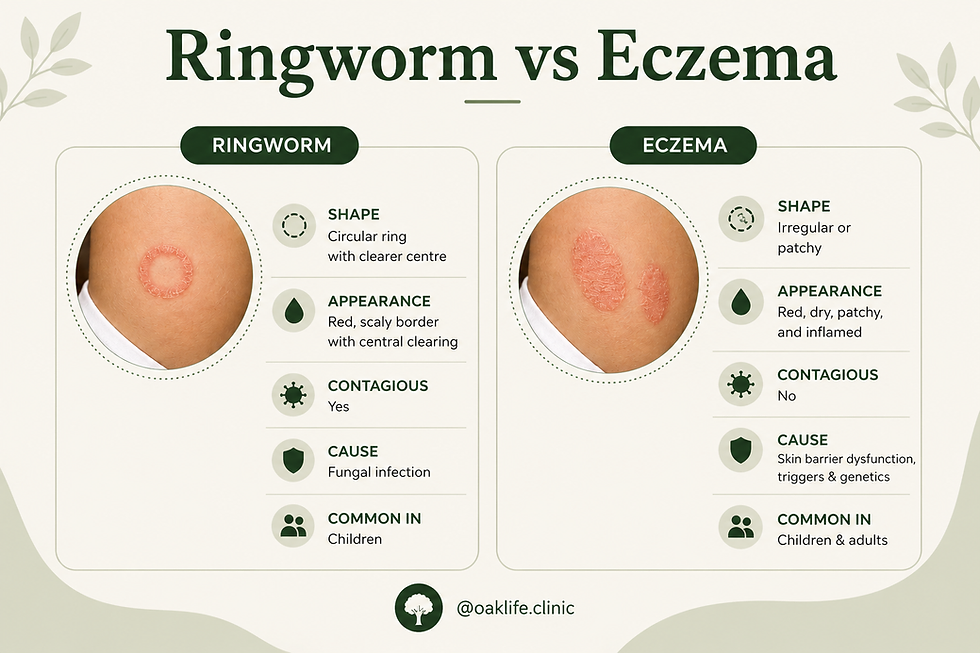
A. Possibly. Eczema and heat rash can both flare in hot, sweaty weather, and they sometimes overlap. Eczema tends to be drier, scalier, and more itchy, often in the cheeks, behind the knees, or in the elbow creases. See our eczema in children guide for more on telling them apart, and bring your child in if you are not sure.
Not Sure What That Rash Is? Come in to Oaklife Family Clinic
When in doubt, a 10-minute consultation usually settles the question — and saves you a sleepless night of Googling. Our doctors see baby and toddler rashes every week, and we will tell you straight whether it is heat rash, something viral, or something else worth treating.
Visit us: 592G Balestier Road, Singapore 329902
Call: 6980 8568
Email: oaklife.clinic@gmail.com
CHAS-approved family clinic — walk-ins welcome.